

TCA #55 - Busting Misconceptions Through Modeling - Making a Fluid Model of Jupiter - Exploration of the Universe with Big Data, Post #5A
TCA 5/1/26: Astronomical Teachniques--Busting Misconceptions With Modeling Techniques, Modeling Gas Giant Worlds; Exploration of the Universe Post 5A--Summary of our Ten Stars, Then A Deep Dive
Cover Photo - Gauging Misconceptions
In This Issue:
Cover Photo - Gauging Misconceptions
Welcome to Issue #55 of The Classroom Astronomer!
Astronomical Teachniques -
- Busting Misconceptions Through Modeling Intro
- Modeling Gas Giant Planets in the ClassroomFifth Post of Exploration of the Universe with Big Data
- Post 5A—Summary of Our Ten Stars Findings Before a Deep Dive
Welcome to Issue #55 of The Classroom Astronomer!
Dear TCA Readers,
I have a pair of interesting Teachniques that have come up during this interim pre-conference period. One is related to the Moon misconception piece last month and the other came from a colleague in the midst of a different discussion….making a model of a gas planet.
This issue has Post #5 of the Exploration of the Universe with Big Data project, on us diving deeper into the data archives for the ten stars of our research list.
As mentioned in the last issue, an astronomical book project dropped into my lap, on a short deadline, but easy to do because I already have most of the material! I had intended to make an announcement in this May 1 issue with a discounted pre-order promotion. It is not quite ready for that but I will send out same in a mid-May issue. All I will say right now is that it will be of interest both to those who like astronomical traveling and those who like observing the night sky all night.
Enjoy!
Dr. Lawrence Krumenaker, Publisher
Email: newsletter@classroomastronomer.com
Website: Classroomastronomer.com
Astronomical Teachniques
Busting Misconceptions Through Modeling
In the previous TCA issue, yours truly relayed a misconception about the causes of Moon phases, that the dark part of the moon (not) seen near the first or last quarter phases is caused by smoke or worse—Earth’s shadow on the Moon. We used a ping pong ball held up to the sky as we pointed it towards the daytime visible Moon in the sky to show they both have the same visible lighted shape. Therefore Earth’s shadow (or smoke) could not be the cause of the dark part, it was due to the position of the Earth, Moon and Sun in space and the lighting thereon for both spheres.
This was part of an article on misconceptions, a part that got pulled out for space (on the page!) limitation. The article that this author wrote has just been published! It is in the May issue of The Physics Teacher, from the American Association of Physics Teachers (AAPT), Volume 64, #5, pp. 430-1. If you are a member of AAPT, it is online at https://doi.org/10.1119/5.0333454 . It is not freely available online to non-members and their copyright rule is it can’t be posted online by the author for 12 months. However, I am allowed to post the final version during the editing process, a PDF that is virtually identical with only very minor word changes! So it is on the Classroom Astronomer webpage, at https://www.classroomastronomer.com/wp-content/uploads/sites/1/2026/04/TPT-miscons-final-submission.pdf.
The idea of the article is to not just do a demonstration but to use the scientific method to gather all the usual hypotheses for some phenomenon and test them all using the same tools and model items and see which hypothesis produces the same phenomenon as observed. The two phenomena used in the two-page article were the causes of the seasons…
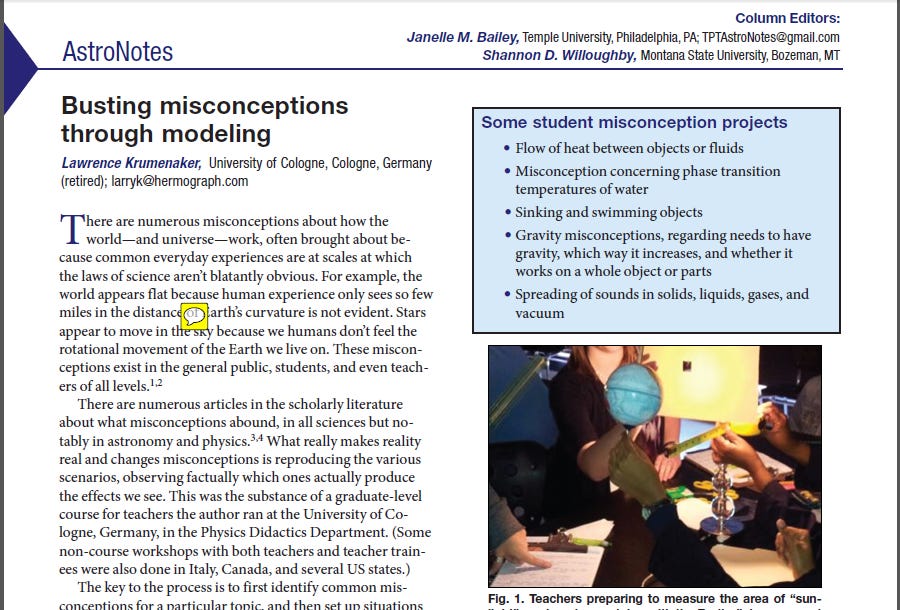
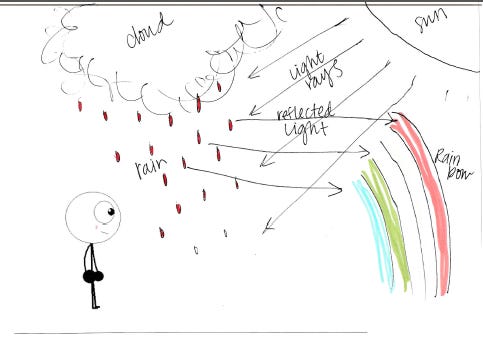
….and the physical location of a rainbow you observe, i.e. the observer, the Sun, and the rain.
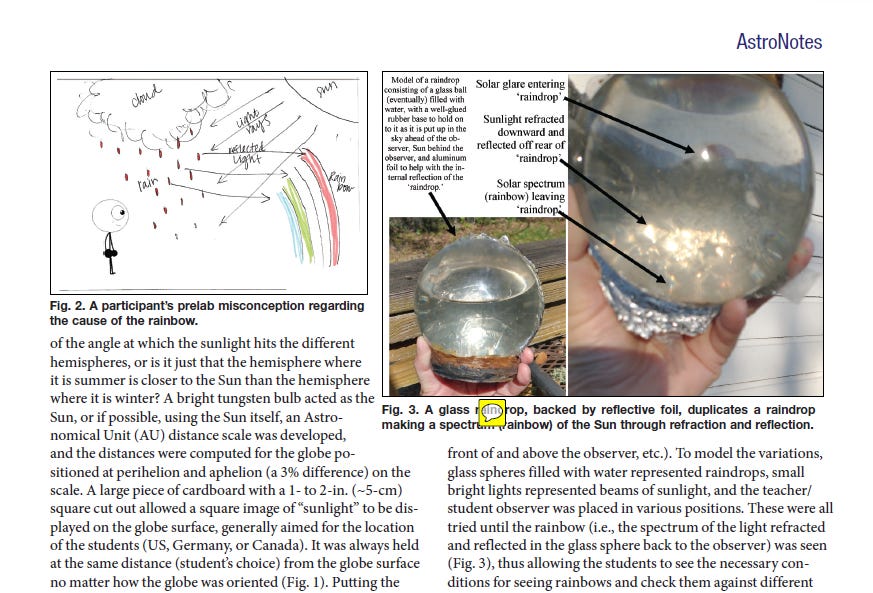
The procedure is to gather from the students (or teachers or pre-teachers in workshops) all the hypotheses and see which are most common, You can do this with private written explanations on index cards or some other communication method such as a template sheet as shown above with the rainbow exercise, that does not produce public answers that may sway other students, which the teacher then quickly summarizes and the most common are announced to be tested with the same model items for all hypotheses. No exceptions, no bias, pure scientific method exploration.
If you are an educator in any form, the method should work for you; just use age appropriate methods and phenomena to explore.
Modeling a Gas Giant World
A colleague and good friend, Dr. Paul Camp of Georgia Gwinnett College in Lawrenceville, GA, relayed to me a Teachnique I had not heard of before. One can make models of solid worlds in our Solar System using solid balls of one kind or another and paint. But how can you model the atmospheric layer viewed in a telescope or by a space probe in a realistic way?
Camp took a spherical fish bowl and filled it with water, placing it on a lazy susan rotating device found often in kitchens, dining rooms or some restaurants to store condiments and such. Eaters can turn the lazy susan to get what they need. A compact and convenient table-top sized storage device.
In his demonstration, he made a Jupiter (or in at least one case, a Uranus or Neptune back in the Voyager days) and put in some shampoo with guanine crystals. Guanine crystals are flat and as they rotate they reflect light and make the shampoo shiny. He also put in a blue dye when representing Neptune, the darker background making things easier to view.
Guanine crystals once were in Ivory Soap Shampoo but it was removed sometime in the past. One must find a supplier who has rheoscopic fluid.
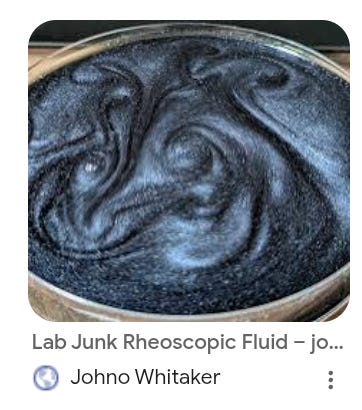
Or, you can make one like what science demonstrator Steve Spangler makes, using 1/4 teaspoon of a mica powder per one liter of water. Or you can buy that online marketed as “Pearl Swirl Concentrate”. Or you can just go onto Amazon.com and find some marketed there! Dye you get in the bakery section of your favorite grocery store.

Exploration of the Universe With Big Data
Post #5A - Summary of Our List of Ten Stars, Then the First Deep Dive
In Posts #4A, B, and C we did our first deep-dive into Aladin to get basic data on our ten stars we are exploring. To summarize the basic findings:
40 (Omicron-2) Eridani - Winter Star, Home of the Vulcans in Star Trek
A nearby high proper motion star, a K0 dwarf spectrum. Oddly, it is listed as a variable star of nearly two magnitudes, and at 12th-13th magnitude instead of the naked eye star that it is, which indicates that Aladin’s data gathering may have problems. But this may be confusing one of 40’s two faint companion stars for the main star. The other companion, by the way, is the brightest white dwarf in our sky.
Aldebaran - Home of a colony in Star Trek
A K0 star, too, but this time a Giant star, also a variable though the label of Long Period Variable seems a bit odd. It is so bright, a first magnitude star, that it has no record in the Gaia catalog. It has a very faint small companion star and an unconfirmed planet.
Wolf 359 - Scene of a major battle in Star Trek
A star very close to the Sun, a very cool M6 dwarf and moving rapidly in proper motion. There are two unconfirmed exoplanets around it.
Polaris - The Pole Star
Earth’s current pole star, a Cepheid variable, with a spectral type a little hotter than our Sun, F8, but a supergiant Ib type of star. Also too bright for Gaia. It is a triple star.
Thuban - Star in Draco the Dragon that used to be the Pole Star
Former pole star, it is the hottest star so far, A0, and a giant, in our survey and a spectroscopic binary. It is in Gaia.
Dubhe - Top Front Pointer star in Ursa Major (Big Dipper)
Bigger but fainter than the Sun, it is at least a double star, possibly multiple, and it is bright in the infrared despite it being a G8 star.
BS Tauri - Irregular variable star with an unexpected periodicity
An Orion or T-Tauri-type irregular variable star, it is very dim, poorly studied, yet with a possible long-term periodicity in its brightness.
BD+21d 255 = K3 - An unusually high galactic latitude S-star
A 9th-magnitude spectral S-star, with Zirconium Oxide molecules in its spectrum. A bit more studied than BS Tauri or the K9 star below, but not by much.
K8 - A carbon star previously published
A 12th-magnitude carbon star, poorly studied.
KU-11 - Another carbon star
An unpublished carbon star, now known for its infrared excess light and as a potential long period variable.
So there are clearly several things to look at—the variability of the stars, the existance of exoplanets, spectral studies including not only the spectral analysis and classificaitons but also for infrared or ultraviolet (or even radio) radiation. These objects are not all in Gaia, the largest catalog, but there are others, such as Hipparcos, that may have data.
What we will do now is start with the last several stars and check out the sparse data sources they have listed, and also check the Vizier links. From there we will find out what all the sources of information are, without their cryptic abbreviations, what they can tell us, and what we can use to explore them. Then we will move up to the brighter stars. The Deep Dive will be posted in a separate mailing in a few days.
- - - - - - - - -